
The continuing saga of economic decline in western democracies… Is Greece the “Canary in the Coal Mine” for how these events unfold? This is a cumulative posting that began in 2012.
Update
I haven’t updated progress on the economy in Greece in quite some time… Well, here you go.
On the political front, the citizens of Greece have decided to vote out the Leftist politicians:
All polls failed to project the sweeping victory of the conservative party, taking by surprise even the most optimistic right-wing politicians. ‘New Democracy’ has a clear 20-point lead over Syriza. Greek Prime Minister Kyriakos Mitsotakis said he would seek a single-party government in the second round.
Perhaps more importantly, Greece has abstained from the political lunacy of other western civilizations, which has led to a resurgence in their economy:
“Essentially, Greece has weathered the last two exceptional crises, the credit crisis and the energy crisis, quite well, perhaps better than the European average,” Daniel Gros, director of the Institute for European Policymaking at Bocconi University in Milan, told Euronews. “And the government has managed to keep fiscal policy under control and is now reaping the fruits of that discipline.”
However, there are some interesting numbers coming out of the real economic picture:
Greece’s GDP grew 8.4% in 2021 and 5.2% in the 4th quarter of 2022… Inflation in Greece in 2022 sat at 9.3%… Unemployment in Greece in 2022 sat at 11%.
September 10, 2021
It appears that there is positive economic progress in Greece:
Greek Prime Minister Kyriakos Mitsotakis said on Saturday the minimum wage would rise again next year and pensions would be increased for the first time since the financial crisis erupted more than a decade ago.
In 2020, Greece’s debt-to-GDP ratio hit a record level of 206.3%. In 2021 it fell slightly to 197.3%. The Greek economy is forecast to grow by 2.9% in 2022 despite inflation in the country reaching a 28-year high, hitting 10.2% in April.
September 17, 2021
Some positive economic news:
The Greek economy grew by 16.2 percent in the second quarter of 2021 compared with the same period last year, with the country’s GDP rising 3.4% compared with the first quarter of the year, led by consumption, private investments and exports, Greek Statistics Authority ELSTAT said on Tuesday.
January 27, 2020
Some relatively positive news on the economic situation in Greece. The Greece Public Debt Management Agency says it plans to issue a 15-year bond, tapping international markets for financing after the country’s sovereign credit rating was upgraded to BB with a positive outlook, citing improved debt sustainability and a “stable political backdrop.”
July 20, 2019
A commentary about the recent direction of Greece from Taki’s Magazine:
The trouble with Greece is over-regulation and corruption. Ironically, Greek oligarchs have a very limited grip on the economy. Oligarchs are not the major obstacle to growth; bureaucracy and over-regulation are. The last four years of socialism have done only harm. That bum Tsipras sold the country down in exchange for outriders during his visits to foreign capitals. He’s now set for life, and the Greeks, being Greek, will vote him back with his new false promises in the future.
December 24, 2018
It doesn’t sound like any improvements:
The Greek government has agreed to even more austerity in the form of more taxes and more pension cuts… Since onset of the crisis, owing to strict Brüning-like austerity demands of Germany and the EU, the economy has contracted by 25%. Unemployment is at 20% and youth unemployment above 40%.
Comments from a Greek libertarian about the reality of the current situation:
Greek public debt went from 130 percent when the crisis began to the present 180 percent of the GDP debt. Perhaps this is an improvement if one works in the Ministry of Truth in Orwell’s 1984, but I don’t. Do these crap bankers and E.U. shills take us all for idiots? Eight years of economic strangulation in order to pay the German banks, half of the middle class of doctors, engineers, and scientists gone abroad, and the extreme left-wing clowns and charlatans who have run the place since 2015 are saying that the chaos is over and everything’s hunky-dory.
August 31, 2018
A recent article in the Wall Street Journal provides an update on the economy in Greece:
It took three bailouts, around €290 billion in loans from its European partners and the International Monetary Fund… On Monday Greece’s third bailout will conclude, and the country will no longer have to rely on its official creditors to finance itself…. The Greek economy has grown slowly in recent years but is still 25% smaller than when the crisis began.
March 6, 2018
According to MarketWatch, Greece’s economy expanded for a fourth straight quarter in the last three months of 2017. Gross domestic product increased by 0.1% in the October-to-December period, compared with an upwardly revised 0.4% growth in the third quarter.
Since entering recession in 2008, Greek GDP has shrunk by more than a quarter amid austerity measures imposed by international creditors after 2010, while unemployment has reached nearly 28% of the workforce.
The country is still in its third bailout program in a row, which ends this August, and the country has sought to convince its creditors that it is finally able to stand on its own feet.
December 6, 2017
According to Bloomberg magazine, there is some positive news about the economic decline in Greece:
Greece’s economy expanded for a third straight quarter for the first time in more than a decade, providing a foundation for the country’s attempts to exit its bailout program next year.
[…]
The third-quarter expansion was led by 5 percent boost in exports, including a 9.8 percent increase in service exports, which includes the country’s crucial tourist sector. Consumption fell 0.1 percent, while investment decreased 6.1 percent in the quarter.
October 15, 2017
It appears that Greece is entering the period of financial fudging:
Indeed, figures for the second quarter have been promising, mainly thanks to tourism. The finance ministry released figures showing a primary surplus slightly above the one projected.
…
In addition, despite Tsipras’ boasting of lowering the unemployment figures, the truth is that more and more people work part-time or at temporary jobs, and get paid third-world wages… In the last week of September, Greece’s largest ice cream factory, Froneri Hellas, shut down, adding 102 people to the unemployment line. Froneri is the latest addition in the long list of once flourishing companies, that has succumbed to the crisis.
Source: Despite Gov’t Boasting over Growth, Greeks Get Poorer
July 11, 2017
From today’s US Today, an update on the situation in Greece:
Two years after an international bailout that was supposed to lead to an economic revival, conditions here have only worsened and life for Greeks has become one of constant misery.
The economy is stagnant, unemployment hovers around 25% and is twice as high for young adults, taxes are rising, and wages are falling. Half of Greek homeowners can’t make their mortgage payments and another quarter can’t afford their property taxes, according to the Bank of Greece.
…
On July 5, 2015, voters soundly rejected the terms of a proposed bailout with international lenders because the plan demanded too much austerity. Yet, Prime Minister Alexis Tsipras and his left-wing Syriza Party ignored the referendum results and signed a third bailout deal that would provide nearly $100 billion in loans the country desperately needed to avoid collapse.
Interestingly, I just had a good friend of mine return from Greece and share his thoughts on the situation in Athens… While tourism is still relatively strong, it’s not a very pretty economic environment for growth.
June 6, 2017
I suppose it shouldn’t surprise anyone that a recent Pew Research poll showed that 98% of the residents of Greece view their current economic situation as “bad.” As a contrast, 40% of Americans consider the current economics as bad.
May 3, 2017
It’s a never-ending story. It appears to be the proverbial “kicking the can down the road”. They’re throwing more money at Greece once again for the promise of more austerity measures:
The preliminary deal with international creditors would allow Athens to receive emergency funds in exchange for promises of higher taxes and lower social spending.
As far as I know, the real solutions are: a) a major write-down of the debt, b) significant steps for economic growth. I haven’t seen either of these in the plans for the Greek empire.
February 7, 2017
It’s now 2017 and there is still no clear path to stability for Greece… and no one appears to have an answer. The economists are now saying that Greece cannot ‘grow’ out of their economic malaise:
The new report was prepared by IMF staff ahead of a February 6 board meeting to discuss the fund’s participation in an EU-led €86bn bailout of Greece and signals the continuing hard line the IMF is taking on debt relief for Athens. It offers a bleaker view of Greece’s economic dilemmas than an analysis prepared last year, warning that the debt load is “highly unsustainable” and would not improve even if it implemented further reforms recommended by the fund. . . .
“Even with these ambitious polices in place, Greece cannot grow out of its debt problem,” IMF staff warned in the report, seen by the Financial Times and drafted as part of the fund’s annual review of member economies. “Greece requires substantial debt relief from its European partners to restore debt sustainability.”
This is a good assessment of the real challenge:
The deeper problem is that Greece does not produce like a developed country, but its citizens expect the level of services and pensions normally associated with a developed country. That’s why there is so much hostility to Greece in the middle-income countries of Eastern Europe, where benefit levels are lower.
June 25, 2016
From the Wall Street Journal, there is no end in sight for the economic decline in Greece…
Mr. Tsipras’s statist ideology is as hostile as ever to the supply-side reforms Greece needs, and both the IMF and other creditors seem to be giving up hope that any other Greek politician could enact such reforms. Which means Greece’s crisis will drag on no matter what happens next with Greece’s debts.
May 8, 2016
The drama continues as the government of Greece passes additional austerity measures:
Greece’s parliament has passed a package of tax and pension reforms, ahead of a crucial meeting of Eurozone finance ministers… Before the vote, protesters in Athens threw petrol bombs at police, who responded with tear gas. Trade unions say the country cannot bear another round of austerity… Three days of a general strike paralysed public transport and slowed the public sector and the media. Speaking before the vote, the leader of the Greek Communist Party, Dimitris Koutsoubas, said the Greek people would “not tolerate nor accept” the measures and would “show their true power” in the event of a yes vote.
April 16, 2016
This article in the Daily Mail should give you an idea of the recent economic progress (or lack thereof) in Greece:
The Greek government fears it could be subjected to terror attacks if a taxpayer-funded mosque is not constructed in Athens. Officials claim it would allow Muslims to practise their religion under the auspices of a centrally-appointed imam that would ensure it does not stray into extremism.
Hmmm… the country is broke, yet it’s using ‘taxpayer’ (in Greece, the word taxpayer should always appear in scary quotes) money to payoff potential terrorists.
January 25, 2016
From the analysts at investors.com, the latest status and outlook:
In protracted and bitter negotiations last summer, the country promised to raise the retirement age, cut pensions, liberalize the energy market, open up closed professions, raise taxes and sell government assets.
There have been encouraging signs. In December, the Greek Parliament narrowly passed overhauls needed to get the next $1.1 billion segment of the bailout negotiated over the summer with the IMF, the European Central Bank and European Commission, known as the troika.
Standard & Poor’s raised its long-term sovereign debt rating to B- from CCC+ with stable outlook, citing the country’s compliance with its economic program.
But the country is a long way from recovery. Third-quarter unemployment was 24% and the economy contracted 0.1% from a year earlier.
Analysts with Deutsche Bank said earlier this month that they expect Greece to slip into deep recession later this year.
September 21, 2015
The malaise continues… a good analysis from Strategy Page:
We know how Greece got here. Greek productivity could not pay for the lifestyle its citizens desired. The productivity of other Euro-zone nations financed Greek good times and kept Greek politicians in power.
Greece lied to obtain the largesse. When the Euro-zone officially formed in 2001, Greece claimed it had a GDP deficit of 1.5 percent. In 2012, former Greek budget minister Peter Doukas said the real 2001 figure was 8.3 percent. Over the years, Greek governments violated fiscal agreements, borrowed money they could not repay and managed to hide the lies. European Union monitoring systems failed to detect the buildup in Greek debt.
The Greek people, who supported these lying governments, enjoyed “other people’s money.” Now German, French and even Italian workers say no more. Italians complain that Greek government worker pensions are far more lavish than theirs. No la dolce vita on our euros.
As for selective law enforcement: Systemic crookedness stymies economic growth. Greeks know it. A June 2010 poll found that 78 percent of the Greek people “accept the view that many or all in government are corrupt.” That same year, a Greek finance ministry investigation uncovered extensive tax evasion, corruption and bribery in its tax collection offices. Greek tax evaders cost the country an estimated $27 billion to $30 billion a year.
Here’s the big story. In Greece, we witness another hard example of an old lesson. Economic reality shakes and eventually shatters political fantasy. Fantasy may fade, but denial tends to die hard. All too often, it dies violently.
June 28, 2015
The saga continues… The Greeks elected a Communist leader that promised economic miracles for the citizenry (sound familiar?); and everyone has discovered the harsh reality of running out of other people’s money. It’s now widely reported that the Greek government is shuttering the banks for a week:
Greek leaders planned to shutter their banks on Monday amid last-ditch discussions about their nation’s economic future, as panicked citizens tried to pull their money from their accounts while they still were able.
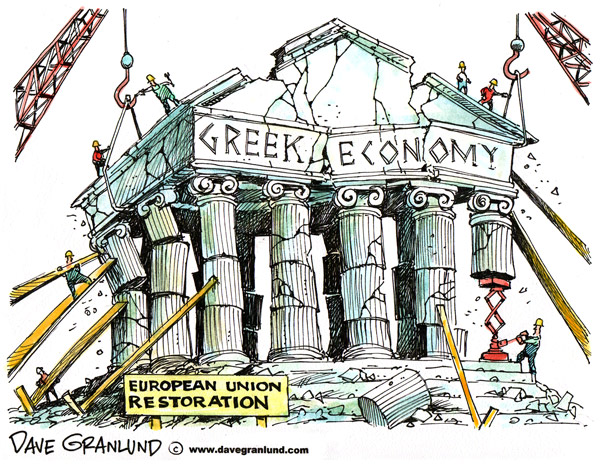
I still don’t know enough about macroeconomics to predict the eventual end game… I suppose the other EU countries will be coming to Athens to repossess the Parthenon.
January 6, 2015
Well, three years later and we have not yet closed the loop on the outcome… Today’s BusinessWeek discusses Greece considering its options:
The current Greek situation is particularly troubling since by as early as mid-year it could constitute Europe’s Lehman Brothers moment. Whatever the outcome of the Jan. 25 parliamentary election, it is difficult to see how Greece can avoid a major policy collision with its European partners. Greece is showing every sign of austerity and economic reform fatigue as its economy remains mired in the deepest of depressions.
February 3, 2014
Yes, the story continues more than two years later, but the plot and results remain the same… As noted at ZeroHedge, Europe pretends to bail out Greece… and Greece pretends to reform and comply with austerity reforms when it merely continues to spend as before until the money runs out…
At this point, I would be willing to say that Victor Davis Hanson has been the best prognosticator (see earlier posts below)
May 9, 2013
The Greek government began its first mass-firing of public-sector workers in more than 100 years this week, part of an effort to lay off 180,000 by 2015 under Europe-imposed austerity.
via Greece starts firing civil servants for first time in a century.
August 20, 2012
More bad news about the Greece economy… They have debt coming due and the country needs to issue more bonds. The Greek GDP shrank by more than 6% over the last 12 months.
I still have that lingering question: How does Greece break out of this continuous decline?
July 24, 2012
The Prime Minister of Greece declares that his country is in a depression (any surprises here?):
Greek GDP is expected by the end of this year to have shrunk by about a fifth in five consecutive years of recession since 2008...
May 11, 2012
You may have missed the Greek elections, but the results are foretelling — the citizens cast quite a few ballots for the Communist and the Nazi parties… the real takeaway that can be generalized for many western countries is that nobody wants to hear about austerity measures. Given a choice between a leader who says “you’ll have to tighten your belt and go to work” versus a prospective leader who proclaims “the government should continue to support your lifestyle”, well, the answer is pretty obvious.
The saga about bankrupt western countries continues to unfold…
May 2, 2012
It’s not getting any better in Athens…

April 5, 2012
It appears that the financial markets are not convinced that Greece has overcome its problems. The Greek 10 year bonds are now hovering around a 20% yield rate (in contrast, US 10 year bonds are approximately 2%).
February 13, 2012
A prognostication from Victor Davis Hanson:
There are only three scenarios likely for Greece: (1) In exchange for debt relief, a liberated Greece changes its ways, opens up its economy, redefines labor and capital markets and becomes a sort of Spain (unlikely). (2) It defaults and its drachma-based country reverts to what one remembered in the old days and what one would expect from a top-heavy, unproductive socialist state (somewhat likely). Or (3) it gets some half-relief, but soon reneges on its promised reforms and austerity, and thus like Greek cities in the 2nd Century AD, life goes on as weeds grow among the impressive, but crumbling infrastructure of the past (very likely).
February 5, 2012
The saga continues… Is the situation in Greece a microcosm of the western democracies and economic decline? A recent issue of the Washington Times discusses how the Greek bailout cycle continues unabated:
The latest examination by international debt inspectors found Greece in such dire straits that it requires another $20 billion cash infusion. This would be on top of the $171 billion promised in October, which was on top of the $145 billion Greece received in 2010…
Greece is not going to escape this repeating cycle of near-collapse and bailout without doing something that sparks sustained economic growth and private-sector job creation. It’s well past time to try something new. The last two years of bailouts and broken promises to cut back on spending have resulted in a shrinking economy and what seem to be daily news of rioting on the streets of Athens. That’s not exactly the best advertisement for Greece’s most significant industry: tourism.
January 31, 2012
The German news organization, Spiegel, is sharing its thoughts on the situation in Greece… They exclaim that European politicians are not facing reality:
Once again, Europe is arguing over a bailout for Greece, and it looks as though the result will be no different that it has been in the past… Europe’s politicians continue to battle reality. Everyone knows that Greece cannot repay its massive pile of debts, now at more than €350 billion ($459 billion). But instead of effectively reducing the financial burden, European politicians intend to approve new loans for the government in Athens and go on fighting debt with new debt.
January 29, 2012
The latest discussion is about Greece changing from using the Euro as its currency:
Germany and the rest of the eurozone can’t actually kick a country out of the euro for fear of investor panic and speculation against Portugal, Italy, Ireland, and Spain. But if Greece were to leave on its own…
January 25, 2012
The situation in Greece has many economists around the world concerned:
The rest of the world needs to sit up and take notice of what is going on in Greece right now. This is what can happen when you allow government debt to spiral out of control. Once it becomes clear that you can’t pay your debts, a financial collapse can happen very suddenly and you start losing your sovereignty to those that you must turn to for financial help.
January 15, 2012
I’ve been watching the situation in Greece with great interest. It possesses all of the leading indicators of great decline associated with a western culture that has embraced Socialism. These indicators include a very low reproduction rate among the indigenous population; huge amounts of entitlements showered among the citizens; and a government expenditure rate well out of line with the country’s gross domestic product.
When a country gets to this point what happens? Do they declare bankruptcy and the creditor nations repossess the assets? Do they hyper-inflate their way out of debt by using their own currency?
Over at the Calculated Risk blog, they talk about the fact that everyone knows that the Greeks are not willing to adopt austerity measures.
At this point, it all sounds like a huge game of “kick the can” as a means to delay the inevitable… of course, I still don’t have a clear picture of the eventual outcome.
Good article.I agree with your questions
Mobile usage is helpful for social media because cellphones have actually social networking abilities,
enabling individuals instant web browsing and use of social network sites.
There’s certainly a great deal to learn about this topic.
I really like all the points you’ve made.